Showing posts with label Research. Show all posts

Sunday, 10 February 2013

Magazine Advert Research - by Josh


 For our magazine advert research, I deemed it appropriate to start with the artist for our video. This being one of Madeon's first tours, a good poster was needed to intrigue audiences and advertise himself as brand recognition. The use of his unique font as well as the relation to his single: 'The City' cover (image below) helps ultimately broad recognition as an artist; when people see one item they are likely to relate that to the other.


 More evidence of this can be seen when I went to see Madeon live; there were T-Shirts on sale with his name and font on them, as well as the 'M' seen in the poster above and the picture below.
 These all have the same colour palette, style and font.


Friday, 1 February 2013

Digipak Research - by Josh

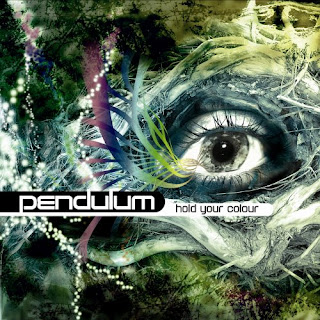
 As part of our coursework we needed to design a digipak for our music video. This first consisted of researching album cover art in our particular genre (Dance/House). The first ones I looked at were the ones that consisted largely of graphics as opposed to one photograph. Below are some of the albums by Drum and Bass band: Pendulum.
http://www.callupontheauthor.com/blog/wp-content/uploads/2010/08/pendulum-immersion-album-art1.jpghttps://blogger.googleusercontent.com/img/b/R29vZ2xl/AVvXsEjBu3AjgptlCAIvtio7jpRDDfljrHUHhB84-dVgzrmJHwewPy1F4NY_NNROM7z6bTA9w_zqIcYhGxhKoRGen63YZWrjTLOqNhSBGm6komdqUe2ghkCPQ8sk4wjaZFbZ6bnP_3Rc8QvmIDyq/s1600/Pendulum+-+Hold+Your+Colour.jpg
 Despite the album art using some pictures (that of the eye in 'Hold Your Colour' and the fish in 'Immersion') the art relies heavily on graphics that surround and emphasise these photographs. I personally really like these album covers as they look stunning and are an illustration of how we are able to create beautiful art simply with a few pictures and photoshop.

 The album name 'Immersion' directly relates to the album art, for a man and a woman are submersed in the sea among many other sea creatures. The intricate and detailed art is also meant to 'immerse' us in the sense that we are drawn in by it.
 'Hold Your Colour' could have a possible relation to the cover as it is made up of many different colours and shades, as well as colour being directly drawn from the eye, which is made to draw our attention, eyes being a focus of many different types of art.
'In Silico' is actually an expression used to mean "performed on computer or via computer simulation", which relates to the computer-generated graphics on the album cover, and could have possible connotations regarding what seems to be a fetus enclosed within an egg with sperm encircling it. This could refer to how Pendulum see their work (the album) as their child, the importance they hold to it and how they have created this through computers. We can draw a comparison between 'Immersion' and 'Hold Your Colour' in the sense that they feature original images that have been heavily manipulated to enhance them, whereas 'In Silico' makes use of simpler graphics. There is a continued house style through the covers as they all make use of heavily edited computer graphics to create the covers but there is perhaps no obvious correlation between the three, i.e. no band members are featured or the same font being used.


 There is no prevalent font through the three albums, and although they do bear resemblance to one another, there appears to be no brand recognition in that respect.
  As you can see from the inside design of 'Hold Your Colour', the concept of the stream of light coming out of the eye is continued on from the cover. This also applies for the song list on the back panel. Light is also shown bursting out of a pair of hands on the design behind the CD, very similar to that of the eye and surrounding inside design. The whole design of the panels uses a similar, dark background with a green, blue and pink/purple colour palette, using white against solid black for the font so it stands our easily.
 'Hold Your Colour' was the main inspiration behind this single (Witchcraft) cover art, the use of the eye being the most noticeable feature they chose to centre both pieces on. Again, this has been heavily edited, perhaps even the eye isn't an original photograph. The reason I believe this looks much more like a single cover art rather than a whole album is because there is only one centre-point for the viewer to look at, this being the eye, which takes up a lot of the whole image with there being little else to be looked at. This differs from 'Hold Your Colour' in the sense that, despite the eye being the main focus-point, it is much smaller than the 'Witchcraft' eye and features more around the whole cover such as the roots around the eye and the bubbles rising up through the title.
  The inside art for 'Immersion' bears similar resemblance to the cover; behind the CD it looks like an empty space underwater which the CD fills up. On the left side you can see the 'thank you's' which consists of a lot of text, thus being the reason the background is kept simple with solid black and only a couple of graphics added in.
  The song list on the right panel above compare very strongly, for the colour palette of black and blue as well as pink/purple are carried on from the front cover. The font for the songs is the same as the album title on the front. There remain some sea creatures as well as beams of blue light from above the water along with coral amongst other rocky features along the bottom, which all feature on the cover.
 The CD art uses original images for the bubbles as well as the jellyfish. This bears strong resemblance to the other four panels as it is underwater, uses black and blue for the colours and the use of the bubbles is meant to emphasise that the viewer has just been 'immersed', thus also emphasising the album title.


http://soundisstyle.com/wp-content/uploads/2012/09/until-now-cover.jpghttp://fanart.tv/fanart/music/99075985-0d80-4692-a15e-b16f78831792/albumcover/until-one-4e421c7cc3fe8.jpg
 The album art above by House supergroup Swedish House Mafia is of their two albums: Until One and Until Now. Their first album (Until One) features a very simple design with formal serif text which could be representative of their plain and formal nature. Until Now on the other hand features the three band members with their iconic three circles behind their heads, perhaps striking a resemblance to the circular halos found behind Jesus Christ's head in pictures of him.
 The electronic group Nero's only album 'Welcome Reality' features futuristic graphics accompanied by the name with their unique font spread across the cover. This is typical of albums; to have the artist name in the centre of the page which becomes the main focus of the art, especially considering the artist's name is far larger than the album name (artist promotion and recognition). It also bears some resemblance to a film poster or DVD cover due to the credits at the bottom of the cover. It seems appropriate for an electronic/house group such as Nero to encorporate futuristic graphics in their cover art, since this genre often makes use of the fact that it seems modern and advanced compared to other genres.

 A possibly more mainstream dance producer, Calvin has had 3 albums, with his most recent one '18 Months' reaching number 1 in the charts. His first album makes relatively simple use of a photograph of Harris edited to give it a cartoon effect. I believe this album art to be quite effective as although it is simple, it stands our quite well, yellow and black contrasting quite differently. It does however still retain a certain techno/dance appeal with the digital font. The second album has some continuity from the first one as the picture has the same 'light-filled' glasses along with the same font. The woman along with the glasses add glamour to the art, possible a metaphor to the album title 'Ready for the Weekend', implying going out to clubs and parties, which seems appropriate since Harris's dance music is very popular amongst clubs. His latest album contrasts highly from his first two, since it doesn't feature a facial close up or the glasses, as well as the text instead featuring prominently in the middle of the cover instead of the to the side. It is, however, another relatively simple album art, with an unedited photograph with Harris sitting on the pavement, which could be described as untypical of dance album covers. An interesting aspect of this album cover is that the background features in Harris's music video for his single 'Bounce'. This is very uncommon in not just dance digipaks but also for all digipaks of every genre, since the album is a collective of lots of singles and isn't just based around one. Harris possibly decided to use this for the digipak cover as artists often want to add in a personal touch to their covers (it being a work of their art), and he may feel that the music video for 'Bounce" relates to his life or bears some resemblance to it.


Friday, 16 November 2012

Director/Auteur - by Josh

 In this post I will be looking at directors, the auteur theory and their relevance to our chosen song and ideas for our music video. Since videos became popular alongside music, there has been a call for music video directors, which contribute massively to what style and how good the music video is. This can vary from the initial idea (performance vs. narrative) to the  camera shots used. The auteur theory links in heavily with this; it is how a director's personal creative vision influences all of the music videos they direct.

John Landis
 The first director I thought I should start with was the one who directed what is commonly regarded as the greatest music video: Michael Jackson's 'Thriller', as well as co-writing the screenplay with Jackson. His wife also designed the notorious red jacket to make him appear more virile. Primarily a film director, Landis was interested in working with Jackson despite film directors not directing music videos at the time. As seen from all the awards Thriller won, including two Grammys: Best Video, Best Video Album and MTV awards: Best Overall Performance in a Video and Best Choreography. Essentially, Thriller was a horror film, or more specifically, a horror-esque music video sharing similar themes from popular horror films; Landis specialised with horror films and was intrigued by the idea of inputting his experience with horror into a music video, which can be seen as his auteur influence. Some of his horror films include 'An American Werewolf in London' and the 'Twilight Zone: The Movie'. Another notable point is that he also directed another one of Jackson's videos: 'Black or White'. This was also another famous video that sold many copies and raised a certain amount of controversy surrounding the violent and sexual nature of the video. Lastly, another point on his auteur influence was his use of credits at the end of Thriller in a similar fashion to that of films.

Tim Brown and Dan Trapp
 Albeit different directors, these are the men who directed 'The City' by Madeon, a video I have analysed in my blog. These two have collaborated together on many different projects with artists of differing genres. The videos they have done together have a similar auteur influence, such as how a lot of the camera focus is on the actors' faces and feature a lot of head shots and closeups in order to show expression and emotion. This can be seen many times from The City (example image right), as well as other videos including the hugely successful 'Pass out' by Tinie Tempah and other, less well known artists such as 'Hit the Ground' by The Big Pink. The most important aspect of their videos is the use of 'breaking the fourth wall'. This shows interaction with the audience and makes the video feel more personal, which is also transferred into their commercial work in TV and on the internet.

Spike Jonze

 A director who has had a long list of music videos to his name, he has done work for artists such as: The Notorious B.I.G, Jay-Z, Fatboy Slim and Arcade Fire. His work varies from genre to genre, but his main focus is on dance and house music. He has also done several films including Being John Malkovich and Where the Wild Things Are. The unique thing about Jonze is his auteur style; his videos are not typical of the normal style in which music videos are filmed, which has led to indie acts like Arcade Fire using him as the director for their music, since the main star image of indie bands is their kookiness and individuality. This auteur style can be seen prominently from what can be regarded as his most famous and best video:

 Featuring the famous actor Christopher Walken, this video had a huge influence on the song's popularity, similar to that of PSY's Gangnam Style; if the song did not have such a popular video, it might not have sold as many copies as it has done. The fact that the whole video is simple a man dancing and flying through an empty hotel illustrates Jonze's unique style with his visionary perspective and simplicity in his videos. This video was so highly regarded that it won 6 awards at the MTV Music Video Awards as well as the 2002 Grammy award for Best Short Form Video. This simple form is portrayed throughout all his videos, as explored with his other video for Fatboy Slim. He was often criticised for this in the early years of his directing career, people often saying his videos were too simple, didn't allow for creative expression and were destroying the art form of music videos. This was highlighted in another of Fatboy Slim's songs: Praise You.

 This film was so different from other videos at the time, it can be seen how Jonze had his critics for this. It is filmed i an almost amateurish style, using a relatively poor camera and from an angle as if it was filmed by a audience member; this video just looks as if somebody with a camera has come across a dance troupe outside a cinema, and to this day, no such professional music video exists that is similar to it, fitting in with Jonze's unique style. He actually starred in the video as the dance troupe leader along with the fictional group The Torrance Community Dance Group, with the intro stating that the video is 'A Torrance Public Film Production', this video at first glances just seems like a amateur music video for a dance group attempting to promote their dancing. Despite all his critics for this video, he went on to win Best Direction, Breakthrough and Choreography at the 1999 MTV Music Video Awards on a budget of $800, which can only be regarded as extraordinary, winning so many awards for such a simple and low cost video which rose to No. 1 in the charts in 1999, the video no doubt contributing to this massively. When Jonze sent a video off to Fatboy Slim of a solo dance of him to the song: Rockafeller Skank by Slim, it was so well received by Slim that he wanted Jonze's fictional dance group as the official video for Praise You.

Friday, 26 October 2012

Madeon Artist Research - by Josh


 Madeon's real name is Hugo Pierre Leclercq and was born on the 30th of May 1994. He first started composing music at the age of 11 and made a name for himself after he won a competition in 2010 by remixing 'The Island' by the drum and bass band Pendulum. He went on to remix various other artists' songs, most notably his song 'Pop Culture' (video below) which consisted of 39 tracks, some of which are:
  • Billie Jean - Michael Jackson
  • Raise Your Weapon - Deadmau5
  • Aerodynamic - Daft Punk 

 Deadmau5 and Daft Punk have been said to be very inspirational artists to Madeon and it seems fitting that he would use them in the song that got him over 14 million hits on Youtube. A notable point in this video is his use of the 'Novation Launchpad', an incredible piece of technology which he used entirely to create 'Pop Culture'. Comprising of 64 buttons it enables the user to remix an song with endless combinations. 

 His first live performance was in Paris in April 2011, where he was a support act to fellow french artist Yelle. His UK debut was at The Nest in London on August 19th 2011 where he performed alongside the french DJ Jacques Lu Cont. He has done numerous live performances since as well as his songs becoming increasingly popular; his song 'Icarus' featured in the US show 'So you think you can dance?' in May 2012, as well as 'Finale' featuring in EA Sports' extremely popular football game: FIFA 13 and in a Sony PlayStation Vita advert. These are all signs of his rapidly increasingly popularity, the fact that companies are using his songs in popular forms of media demonstrates his rising fame - at the age of only 18, he is set to perform many live concerts (image below) across Belgium, Germany, Holland, France, England and Scotland, me and my partners are attending the London date at the Electric Ballroom.


 Although he is French, it is interesting that he should play so many gigs around England, which is most likely down to his music being largely in English - e.g. the songs 'Finale' and 'The City' are in English. It is also possibly due to his music being quite advanced in the sense that he is ahead of other music producers in France, England being more advanced in music than France; new, English sung artists are continuously coming up with new and advancing genres, e.g. Foster the People with their unique alternative rock/dance music that is unlike any other band.

 Below is his discography. Although he hasn't done many singles and songs entirely of his own content, this can be put down to him being quite young and not having been on the music market scene for that long, only composing 3 songs throughout the whole of 2012. However he has done 11 remixes and mash-ups in total, since this is a lot me convenient for a DJ to do than doing a song used entirely from user-created content; many DJs remix and mash-up other songs as a way to gain popularity and to show how they can creatively turn preexisting songs into their own version of that song. A good example of this is Madeon's remix of Deadmau5's 'Raise Your Weapon' and Pendulum's 'The Island', these are largely how Madeon grew to fame, not forgetting his most popular mash-up on Youtube: 'Pop Culture'.


Monday, 22 October 2012

Analysis - Madeon [chosen artist] - by Josh

 The last video analysis I have done is the music video 'The City' by Madeon, the chosen artist for my music video. I deemed it appropriate to analyse in detail a video done by the artist whose song I am doing to get a real sense of what his style and image is. Therefore, when I film my music video along with my partners, we will have some ideas of what to do when it comes to planning the video. Below is the music video for The City.


 Upon first viewing, I instantly liked this video. The song alone creates a sense of having a good time and the video helps to emphasise this. There is a constant presence of the major key throughout this song, as well as other voices that join in with the main singer in places for added effect.


Music
 In terms of the music relating to the video, I believe there to be a significant link between the style of the music and the style of the video. A lot of Electro House music videos generally have lots of people in them having a good time which is what this genre of music is mostly used for. Seeing people having fun whilst listening to this song will influence the way the audience views this song. I listened to the song without watching the video and although it sounded great and did indeed portray the sense of fun and partying. This only furthered my belief when I listened to the song again whilst watching the video. The actual video is a paint war where one side is trying to rescue a hostage from the other team. It has a sense of seriousness about it but the idea of paint being used instead of lethal weapons destroys this image. The vibrant colours in the clothing, paint and the bright urban landscape emphasises that this is not a deadly, fatal environment but more of a competitive one, similar to that of paintball; the serious attitude is there but without the deadly consequences, which captures the exciting nature of the game and the song combined.

 As with many music videos, the editing is driven by the song since a lot of cuts and transitions are made to directly correspond with the song; since there is a distinctive beat to the song it is clearly evident throughout the video. This is most prominent from the video below:


 As the song reaches its climax (0.58) the beat is clear and the video reflects this with quick cuts with the camera bouncing around to emphasise the people running, thus creating the sense of an action video. There are many cuts that last only a fraction of a second until 1.11 where the song slows down, the singing stops and what is seen in the video also slows down, making use of slow-motion to emphasise this (where the man raises the bazooka to the building). At 1.14 the singing comes back and relatively quick cuts (albeit not as fast as before) are seen. This proceeds with the people on the floor below being attacked by paint from those upstairs, with many closeups of the people and the paintballs shown to accentuate the battle between the two groups, such as the serious expressions shown by the people above and the fear by the people below.


 An extremely important point in the relationship between the video and the music is at 1.42 where the music dies down for a few seconds and is brought back to life by the line "so here we go" which can be seen as the signal for the beat at 1.44 which directly links in with the shot of the bazooka, striking the building and bursting into a colourful cloud of orange dust. This launches the video into the same fast sequence to match the chorus with short quick cuts. More people appear as the battle ensues into a raging conflict with many paints being thrown. This continues until 1.58 when the song slows down with few significant beats, apart from those that accompany the cuts from each closeup. This brief sequence could be to portray the emotions shown by the participants and the progress of the battle at that time; the sternness of their expression is matched by their faces covered with paint, indicating that the battle has been going on for some time and are in the main stage of it, perhaps inclining that the song is also in the main part.


Lyrics
  Although there are no evident direct links between the visuals and the lyrics at first glances, when looked at in more depth you can see that there are some subtle meanings behind the lyrics and even the title. "I can feel the city crumbling around me" does relate to the video, the setting being an urban city with unused buildings, "crumbling around me" did possibly have an influence on the location since the whole video is filmed within and around unused and derelict buildings (image left)."But I can see a bright light calling through the dark night" could also be a reference to the brightly coloured paints that being thrown throughout the video, considering the paints to light up and colour the desolate landscape. This is also reflected and directly influenced in the title for the song (image below), with the background being a blank canvas which is brought to life by the vibrantly coloured title with bright and contrasting colours that stand out against the background, which can be seen as having a direct correlation with the video; the paints lighting up the city, actually sharing the same colours and, if you look closely, you can see that the title has the texture of the dry paints used in the video.

 "There is a place in the distance, A place that I’ve been dreaming of, No more time and space don’t exist there, We can dance like there’s no tomorrow, There is a place, no time in space". The opening lyrics here could be descriptive of the derelict buildings, and how this place exists in the singer's dreams, which he is going to make come to life as seen in the video. "We can dance like there's no tomorrow" I believe relates to the nature of the paint war; the dance is their fight and they will fight like they know they won't live to see another day, they will give it their all. "There is a place, no time in space" can be seen as the deserted area in which the buildings are situated, the fantastical place has no time and space and could merely be a creation of the singer's mind, a place to retreat into, or even his idea of a heaven in which exists his ideal world with no physics that can represent the real world.

 "I can feel the heartbeat underneath the concrete, Just like a kick drum plays, Running in a straight line guided by the street lights, Pushing the dark away". The "heartbeat underneath the concrete" line could represent the life of the people in the video that bring the city to life, just as they are the people "running in a straight line guided by the street lights, pushing the dark away"; they are one with the city and they need each other to survive.

There is a place in the distance
A place that I’ve been dreaming of
No more time and space don’t exist there
We can dance like there’s no tomorrow
There is a place, no time in space

I’ve got tomorrow to
I’ve got to go all the way
I’ve got tomorrow to
I’ve got to go all the way
I’ve got tomorrow to
I’ve got to go all the way
I’ve got tomorrow to

I can feel the city crumbling around me
I can’t seem to find my way
But I can see a bright light calling through dark night
Hoping I’ll find my way

Yeah I had what I wanted
It went away so fast fast
Yeah I got to let go
We can dance like there’s no tomorrow
So here we go

I’ve got tomorrow to
I’ve got to go all the way
I’ve got tomorrow to
I’ve got to go all the way
I’ve got tomorrow to
I’ve got to go all the way
I’ve got tomorrow to

I can feel the heartbeat underneath the concrete
Just like a kick drum plays
Running in a straight line guided by the street lights
Pushing the dark away

Yeah I had what I wanted
It went away so fast fast
Yeah I got to let go
We can dance like there’s no tomorrow

There is a place in the distance
A place that I’ve been dreaming of
No oh time and space don’t exist there
We can dance like there’s no tomorrow
There is a place, no time in space

There is a place in the distance
A place that I’ve been dreaming of
No more time and space
We can dance like there’s no tomorrow
Oh oh oh!

I’ve got tomorrow to
I’ve got to go all the way
I’ve got tomorrow to
I’ve got to go all the way
I’ve got tomorrow to
I’ve got to go all the way
I’ve got tomorrow to

Tomorrow
Tomorrow
We can dance

Concept
 A very important concept I picked up when watching this video was that this video relates heavily relates to the Hindu festival: Holi, the festival of colours (video below).

Holi is the celebration of colours and a new season, and as you can see from the video, the participants are having lots of fun, directly relating to The City. It is celebrated by throwing paints and perfumes at each other as a way of representing the new colours of the new season. This can be seen as a way of representing Madeon's colourful and creative personality.


Friday, 12 October 2012

Song Choice - by Josh


 For our video me and my partners, James and Luke decided that we wanted to do a song by a relatively unknown artist, so their image wouldn't play in with how we were going to shoot the video. We also decided to base our video largely on narrative instead of performance as we found narrative type of videos much more interesting than simple performance ones. This also ties in with popular culture as artists are constantly going for more and more narrative type videos, seeing narrative music videos as a way for them to express their image, style and creativity.

 The song we have decided to choose is 'Finale' by the fantastic new 18 year old French Electro House/Pop artist: Madeon.


 We are thinking of basing our location for shooting in London so we can have a good looking, urban landscape. You can actually see from his name logo that it is the Sydney cityscape, which was one of our main influences when deciding on our location.

Lyrics
(Aahoo hoo hoo)
Brace yourself
Brace yourself
(Whoo hoo hoo)

Your last chance,
last summer,
your last dance,
to beat to your own drummer.
Go out fighting.
Go out young.
A flash of lighting.
Clips the Sun.
(2x)

Brace yourself, brace yourself.

(Brace yourself for the grand finale!)


Your last chance
last summer,
your last dance,
to beat to your own drummer.
Go out fighting.
Go out young.
A flash of lighting.
Clips the Sun.

Brace yourself,
brace yourself

Thursday, 11 October 2012

Analysis - Foster the People - by Josh


 The second video I have chosen for my video analysis is 'Houdini' by the Indie Rock band: Foster the People. I have referenced this song and video in my past posts as I find it to be an extremely good video. I have included a video below of me detailing particular aspects of the video which I found particularly good. Below the video is my more detailed analysis of the music video.


Music

 Since most of the video is narrative, there are only a few performance point of views but during the performance sections there is a strong relationship between the music and visuals, which we first see when the main riff of the song comes in. This is when the band members are crushed by the stage lighting (image right). 


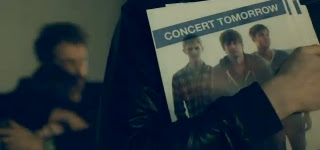
One thing that I picked up on here was one of the crew members holding the lead singer (image left), which is quite a common theme in films where a tragedy has just occurred, and the band's death is seen as a tragedy since they are meant to play a concert tomorrow (image below).


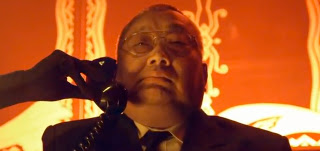
The verse is filled with the narrative section, and in the first verse we see the band's boss/manager hear about the news (image left) at which the dead band members are promptly turned into puppets and acted out by puppeteers in the first chorus (images below).


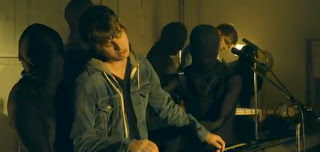
When the instrumental kicks in the lights turn off and a black backdrop falls down; the band looks as if they are playing their instruments and then proceed to dance as directed by the puppeteers (image below).


 In the next verse we see the band being turned into robots which leads up to the instrumental at which they are flung into the air to emphasise the chorus (image below right).


What I think is clever here is the use of overcranking just before the instrumental begins and it reverting back to normal speed to match the pace of the song. There is repeated use of overcranking again in places to emphasise the pace of this part of the song, as well as the lights flashing to hide cuts and keep with the beat of the song (image left).


 During the bridge the band is playing at a live gig in front of an audience, the camera capturing the energy of the song and audience through slow-motion of shots of the audience (image right). The lights flashing in time with the beat of the song, the audience jumping up and down and the raised voice of the singer indicate that the song is drawing to a climax which is matched on screen. 


As the band jumps up from their instruments the camera follows them and suddenly raises up again to emphasise them landing on the stage, at which they start their dance which has played a key part throughout the song (image left).


A lot of the bridge is filmed from behind the audience to try and make the watcher feel as though they are there in the audience watching the band (image right).


The camera again shows the band's clothes ripped off in slow motion to be replaced with white clothes (image left).


 They are joined by more dancers and the camera pans to reveal the audience dancing in unison with the band (image right) which emphasises the audience's enjoyment, thus influencing how the watcher feels about the song.


The singers voice raising in tempo and sound to draw the bridge to a close at which point the band members are again with their instruments and confetti shoots into the air (image left).


The outro plays in with the visuals as one long shot is showing all the workers are celebrating, the song and video ending on the 3 band members lying on a sofa (we as the audience are to presume they have been shut down as they are robots) (clip below).


Lyrics
Pre-chorus:
Got shackles on, my words are tied / Fear can make you compromise / Fast enough it's hard to hide / Sometimes I want to disappear

"My words are tied / fear can make you compromise" means that no matter how much you prepare for a speech, or debate, or any other type of public speaking, when you stand up there for real, you experience distress and you suddenly forget everything you're about to say. And what do you do when you forget everything? You feel embarrassed, and you want to "disappear."

After the chorus is repeated for a second time, a second voice is added to the song, and I believe this is the person's subconsciousness telling them to stand up, and focus on their ability, what they've prepared so long for, and that they have nothing to fear.

Bridge:
"Gain again what they want to steal / Gain again what they want to steal / Gonna gain again what they want to steal / Gain again what they want to steal"

"They" are the audience. The people who mock the speaker for their lack of bravery. What they want to "steal" is his self-esteem- that is, they want to take his confidence away, and the presence of them makes the speaker gravely embarrassed. To "gain again" what they want to "steal" means to recover from the initial shock of standing in front of your peers, gather up your self-esteem again, and just do it.


 There are certain points at which the lyrics tie in with the visuals, which we first see when the singer is being turned into a robot and the scientists are trying out his lips at pronouncing the words (image left).


 I think the best representation of the lyrics however is the dance that keeps repeating, as the whole song is about ability, the band is showing their ability through the dance. The second voice keeps repeating ability in the bridge which directly relates to the band members being turned into robots, inclining at the fact that band managers want ability which is something that humans do not have but robot band members do.
 
Concept
 I reckon the song is called Houdini because he was an escape artist, and this shows that you can't escape from the music company`s hands, even if you die you will be used as a puppet in the music industry which is clearly illustrated throughout the video. I believe the actual song is centered around ability (which links to the robots having more ability than humans), and about standing up for yourself in spite of your peers using your ability. It addresses important aspects of the music industry revolving around companies and managers, that they will use people even when they are dead to get money. 
This video raises some important notions of the music business, especially from the point of view of the artist(s). Mark Foster (the band's lead singer and songwriter) is trying to express how sometimes the music industry and artists are controlled by the producers, and how they are willing to go to any lengths to make sure they get money out of the artist (as seen by the band's boss in the video).